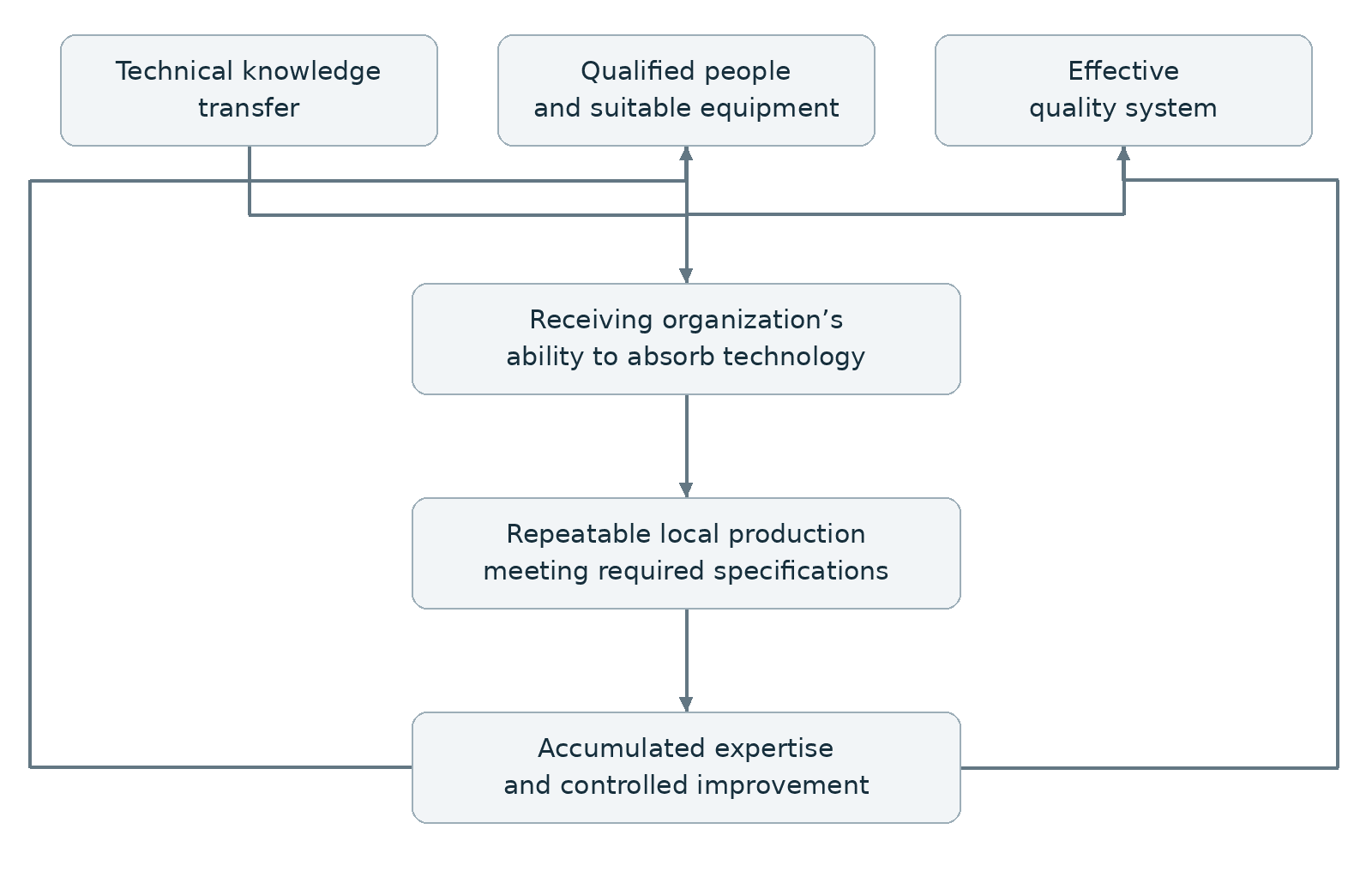

Does a medicine leaving a production line in Saudi Arabia mean that the capability to manufacture it has been localized? The answer depends on what the organization can do when operating conditions change, a deviation occurs, or intensive support from its technology partner ends.
This question should guide pharmaceutical localization in Saudi Arabia. Local production establishes where manufacturing takes place. Building local capability requires knowledge to explain the process, people to execute it, and systems to maintain its quality. A project may begin with a limited manufacturing scope and deepen over time. That scope must be clear, with acquired capabilities assessed accordingly.
Why Does Pharmaceutical Localization in Saudi Arabia Matter Now?
The National Biotechnology Strategy places capability building within a long-term economic and health ambition. Launched on January 25, 2024, it aims for regional leadership by 2030 and global leadership by 2040. Its priorities cover vaccines, biomanufacturing and localization, genomics, and plant optimization.
For manufacturing, the National Biotechnology Strategy outlines end-to-end vaccine capabilities and an advanced local platform for biologics and biosimilars, supporting self-sufficiency and exports. These are stated ambitions, rather than evidence that those capabilities are already fully established.
I see this direction as a reason to reconsider project evaluation: what knowledge will accumulate locally, who will retain it, and how will it become reliable industrial performance? Strategy establishes direction; organizational readiness determines the ability to contribute.
What Capability Should Remain Within the Organization?
Through my work across manufacturing, biologics, and regulatory affairs, I view localization from both a facility and an organizational perspective. Equipment enables operations. The organization must understand the process, allocate resources, and make decisions when results differ from expectations.
My career has included co-founding an anti-venom and vaccine production center and developing pharmaceutical businesses connecting manufacturing, distribution, and market access. This informs my view of manufacturing as an integrated capability whose value depends on consistent performance and what ultimately reaches patients.
The measure I consider most meaningful is the knowledge and operational capability retained within the organization, within the scope of the transferred technology, enabling continued learning and controlled improvement.
First: What Must Be Transferred Alongside the Technology?
Product, process, and testing knowledge must transfer alongside the documentation needed to apply it. The WHO guidelines on technology transfer describe successful transfer through documented evidence that the receiving organization can routinely reproduce the product or process against agreed specifications.
Operationally, handing over instructions does not replace explaining their rationale. Teams need to understand quality-critical variables, acceptable operating limits, and the reasoning behind technical decisions.
When an unexpected result appears, can the team interpret the data and conduct a scientific investigation, or does every case require external interpretation? I therefore recommend practical training, case reviews, and acceptance criteria that assess understanding. Rights to access and use knowledge should also be explicit, consistent with licensing and intellectual property arrangements.
Second: How Does the Receiving Organization Absorb the Technology?
An organization absorbs technology when its people, equipment, and working practices meet the transferred process’s requirements. WHO recommends assessing technical, regulatory, and quality gaps, providing qualified and trained personnel, and understanding differences between the sending and receiving organizations.
From an executive perspective, this assessment should precede firm timelines and investment commitments. Training introduced late may expose gaps that could have been addressed during planning.
I prefer assessing competence through specific tasks: interpreting analytical results, executing a procedure correctly, or evaluating an operational difference. Course attendance measures activity; demonstrated capability measures readiness. Knowledge should also be documented and distributed across the team so that continuity does not depend on one individual. International partnerships remain valuable, with clear responsibilities that the local organization is equipped to assume.
Third: How Do Quality Systems Make Capability Repeatable?
Quality systems embed knowledge in daily operations and provide a basis for reviewing and improving performance. The Saudi Food and Drug Authority’s GMP Guide assigns senior management responsibility for an effective, adequately resourced pharmaceutical quality system. It also emphasizes defined processes and validation of critical steps and significant changes.
Their value becomes evident when investigating deviations or proposing process changes. A written procedure alone does not demonstrate understanding. Appropriate investigation, evidence-based decisions, and follow-up are needed to establish whether corrective action has worked.
I therefore consider quality integral to project design, budgeting, and governance. When disconnected from production and expansion decisions, manufacturing capacity may grow faster than the organization’s ability to control it. Does leadership provide the time, resources, and authority needed to sustain reliable performance?
What Does This Mean for Investors, Manufacturers, and Partners?
Investors should include the cost of acquiring and sustaining capability in feasibility assessments, covering training, quality, and technical support. Manufacturers should link expansion to readiness evidence, grounding capacity increases in established process understanding.
International partners should agree on knowledge scope, transfer responsibilities, acceptance criteria, and subsequent support. For policymakers, indicators of workforce competence, process stability, and the depth of transferred activities can complement investment and production figures. These are proposed evaluation measures, not substitutes for regulatory requirements.
What Do I Look for When Assessing a Localization Project?
I begin with three questions:
- Has knowledge transferred that the team can explain and apply, with clear usage rights?
- Has the receiving organization demonstrated readiness, with remaining external support needs defined?
- Does it have the quality system and resources to sustain performance and manage change?
Executive Conclusion
The National Biotechnology Strategy creates opportunities to advance pharmaceutical localization in Saudi Arabia. Translating that ambition into practice remains a responsibility within each project. My priority is to fund capability building from the outset and reassess it at every expansion stage.
Successful production can then become the starting point for accumulating local expertise. As organizations turn knowledge into reliable performance and controlled improvement, they strengthen their ability to serve the Kingdom’s needs and participate in pharmaceutical value chains.